April 7, 2014
NEWS: Australia’s youth get their own Digital Community Radio platform
January 20, 2014
NEWS: ABC1 drops kids content (AUSTRALIA)
Australian pubcaster ABC is to drop children’s programming from its flagship channel ABC1 and move it to dedicated children’s channels.August 7, 2013
October 30, 2012
NEWS: Teenager Ciara Ierace appointed Children's Commissioner for a day (AUSTRALIA)
As part of a campaign to promote positive body image for youngsters, 13-year-old Ciara Ierace worked with brand and communications agency Meerkats to produce a print advertisement.August 1, 2012
OPPORTUNITIES: Video competition against cyberbullying (AUSTRALIA)
Join BackMeUp and take a stand against bullying. BackMeUp is a video competition to help eliminate cyberbullying in Australia! February 1, 2012
ARTICLES: Fat Free TV – one step towards tackling childhood obesity
The impact of junk food advertising on childhood obesity is a topic often debated in the media. One side calls for banning junk food advertising during children's television viewing times while the other questions whether ad bans will work, decrying a "nanny state".
October 9, 2011
ARTICLES / OPINIONS: Rated G for garbage (AUSTRALIA)
Why our children refuse to watch the local TV shows made just for them.
AUSTRALIAN children are choosing 35-year-old American sitcoms over local programs specifically designed for them, including those on ABC2 and the children's channel, ABC3.
The policy initiatives that rocketed Australia to prominence as an international children's television producer in the '80s are still in place, yet today's children prefer to watch Here's Lucy, I Dream of Jeannie, Bewitched, Happy Days and Mork and Mindy.
This despite rules around program standards, specific Australian quotas, subsidised financing and a Children's Television Foundation designed to innovate and create ground-breaking concepts.
So why, as Screen Australia's Convergence 2011 report points out, don't Australian children want to watch the Australian programs that are being produced for them?
September 18, 2011
NEWS: Australian kids 'not watching age-suitable shows'
Friday 16 Sep 2011 - Since the arrival of new digital channels, Australian children as young as one are watching TV programmes that may not be appropriate for their age, The Sydney Morning Herald reports. Screen Australia's research has found that while TV networks are bound to broadcast minimum amounts of children's programmes during the peak children's viewing slots, many children are either watching TV outside these times or watching programmes not aimed at them, largely because many more channels are now available.
September 12, 2011
ARTICLES / RESEARCH: Textese gr8 training 4 poets of 2moro
Research has linked children's use of text abbreviations with improved literacy.
THEY'RE at it wherever you look - on the bus or train, even just walking to school. Students seem fixated on their mobile phones, nimbly tapping out text messages such as ''Wen wil i c u 2night? Cos sum1 left a msg bout ur frend bein sik. R u sik 2?''
This tide of texting has prompted warnings that the technology is leading to a decline in language skills. So are children losing the capacity to read, write and spell well?
The answer: Probably not.
Indeed, new research has found a strong link between primary school children's use of text abbreviations and improved literacy.
August 11, 2011
ARTICLES / ARTS: I, Bunyip at the Sydney Children's Festival (AUSTRALIA)
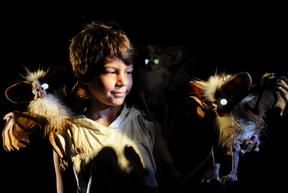
Presented by Sydney Children’s Festival World premiere performances of new work from Erth CarriageWorks Monday 26 Sept – Saturday 8 October, 2011 Do you know what a Bunyip is? Have you ever seen one? What about other secret spirits and creatures that live in Australia? Would you like to meet them?
This year at Sydney Children’s Festival, Erth Visual and Physical Inc present I, Bunyip: a unique performance of puppets, visual effects and multi-media that takes audiences deep inside the mysterious heart of Australian imaginings. Long known for their magical, life-like puppetry and performances, Erth’s shows have transfixed children across the globe. I, Bunyip promises to be equally mesmerising, with an inimitable cast of unique Australian characters brought to life on stage.
June 10, 2011
ARTICLES: TV still a big deal for young (AUSTRALIA)
A study by Sesame Street's children's workshop found while TV remained a solid favourite with children, they were increasingly turning to computer games and mobile media as technology evolved.
But for younger children, TV continued to exert a strong hold.
''TV is readily available to children and for the most part, is a routine part of their day,'' the report says.
''Even as use of other media rises, television persists.
''It is by far the dominant medium used by children ages zero to 11.''
February 11, 2011
RESEARCH / ARTICLES: Kids watch 15 hours of TV a week (AUSTRALIA)
She does not let the television dictate her life, but do not stand between 11-year-old Kayley Collier and an episode of Neighbours. The Twin Waters youngster watches nearly half the amount of television in any given week when compared to other children in her age group.
New data released this week as part of the Young Australian Survey by Roy Morgan Research detailing children’s top media choices showed children aged between six and 13 spend more time watching television than any other media.
On average, they spend 14 hours and 48 minutes in front of the tube in any given week.
April 4, 2010
ARTICLES: Rich kids' secret of success: less TV

by Danielle Teutsch - April 4, 2010
THE country's wealthiest students spend three hours a week less than their poorer peers in front of the television or playing video games, and instead spend the time doing homework and playing sport.
Research has shown that the wealthiest 30 per cent of Australian children spend more than half an hour a day more than other students at school, studying, reading and doing music lessons. They also spend 20 minutes more each day playing organised sport, and 10 minutes more eating.
The payoff for parents is that they spend 42 minutes less watching television or playing video games.
full article
March 1, 2010
ARTICLES / CHILDREN'S TV: Classifications 'don't match children's development' (AUSTRALIA)
A representative of the council this morning addressed a Sydney hearing of the Federal Government's long-running inquiry into the impact of violence on young Australians.
Dr Wayne Warburton says the current classification system does not match up with some of the developmental stages of younger children.
"Eight is a kind of critical age. I think you [should] look at what works for kids under eight and what works for kids over eight," he said.
"Thirteen is another important milestone because it's the beginning of that search for identity in 'who am I?'
"I think we need to be careful of what happens between about 13 and 16."
Dr Warburton says while reality television has encouraged some bullying behaviour, the content has been improving in recent years.
full article
October 25, 2009
NEWS / CHILDREN'S TV: ABC to launch dedicated kids' channel (AUSTRALIA)
ABC3 bows December 4, aimed at ages 6-14
By Pip Bulbeck
Oct 22, 2009, 01:03 PM ET
Announcing the on-air date and the channel's new hosts, ABC director of television Kim Dalton said “Australian kids will get an innovative, new entertainment experience; one which is designed to challenge and excite them.
Australian kids, he said, deserve “better quality content, that speaks with an Australian voice and a better variety of programs, that caters to different interests and tastes.”
The channel will feature both local and international programming across a range of genres including live action, drama, animation, sports, current affairs and game shows all funded with AUS$67 million ($64 million) from the federal government. ABC3 will launch with over 40% local content, expected to expand to over 50% within 12 months.
full article
June 8, 2009
NEWS / ARTICLES: Kids targeted in net ad push (AUSTRALIA)
Simon Canning | June 08, 2009
MARKETERS are joining children in turning off the television and shifting their advertising attention to the unregulated world of the internet.
There they are creating new levels of interaction with their consumers while raising deeper concerns with web-challenged parents. Social networking sites, game pages and video portals are becoming the preferred choice for brands that at once are providing large chunks of content while also gaining valuable information about growing consumers.
Even "walled garden" websites such as Disney's Club Penguin, which does not allow advertising, have been accused of trying to push subscriptions by showing toddlers content on the free site that can only be accessed on the paid site.
Experts admit little research has been done on the impact of advertising to young children online, even as digital media has become the preferred choice in many households with the growth of broadband.
Barbara Biggins of Young Media Australia, a longtime campaigner for restrictions on advertising aimed at children, said while there had been extensive research into the impact of TV advertising on children, the internet remained uncharted territory.
"There is a lot we just don't yet know and not a lot of research has been conducted," Ms Biggins said.
full article